





If you’re still managing appointments using spreadsheets, notebooks, phone calls, and WhatsApp messages, you already know the stress that comes with it.
Double bookings.
Missed service calls.
Technicians arriving at the wrong address.
Customers saying, “No one showed up.”
Scheduling issues don’t just waste time; instead, they cost revenue and hurt your reputation.
For many field service businesses, like HVAC, plumbing, electrical, cleaning, appliance repair, this becomes the turning point.
You start asking: Should I keep handling scheduling manually, or is it time to use field service software?
In this guide, we’ll compare manual scheduling vs automated scheduling in real-world terms, especially for service businesses that rely on technicians, dispatching, and work order management.
What Is Manual vs Automated Scheduling in Field Service Management?
Manual scheduling means coordinating jobs through spreadsheets, diaries, calls, or messaging apps.
Automated scheduling uses field service management software or dispatch software to:
- Assign technicians
- Manage work orders
- Sync calendars
- Send reminders
- Track job status
- Centralize scheduling
Manual systems depend on memory and communication, while automated systems reduce errors and improve visibility. That difference becomes critical as your business grows.
Why Scheduling Is the Backbone of Field Service Operations
In a field service business, scheduling is not just admin work. It is the control center of your daily operations.
Every job starts with a schedule. Every technician’s day depends on it. And every customer judges your business based on whether you arrive when you said you would. Scheduling directly impacts:
a) Technician utilization – When schedules are clear and optimized, technicians spend more time working and less time waiting, traveling unnecessarily, or calling the office for updates. Better utilization means more completed jobs per day.
b) Work order efficiency – Proper scheduling ensures the right technician is assigned to the right job with the right information. That reduces repeat visits, confusion, and delays.
c) On-time arrivals – Missed time slots damage trust quickly. A structured scheduling and dispatch system helps prevent overlaps, route confusion, and last-minute chaos.
d) Customer satisfaction – Customers don’t see your internal systems. They only see whether you show up on time, communicate clearly, and complete the job smoothly. Scheduling plays a direct role in that experience.
e) Revenue per day – The more organized your job scheduling and dispatch process, the more appointments you can complete without adding stress or extra staff. Better scheduling increases daily earning potential.
If your dispatching system is weak, whether it’s spreadsheets, phone calls, or scattered calendars, everything else suffers. Jobs get delayed. Technicians get frustrated. Customers lose confidence and revenue becomes unpredictable.
That’s why many growing service businesses move from manual coordination to dedicated field service scheduling software or a complete field service management system.
The Real Cost of Manual Scheduling In Field Service Businesses

Manual scheduling may look “free.” But it creates hidden operational costs:
a) Lost revenue from missed appointments – When bookings are forgotten or poorly communicated, empty time slots directly reduce your daily earning potential.
b) Double-booked technicians – Overlapping jobs create delays, frustrated customers, and stressed teams trying to fix preventable mistakes.
c) Extra admin hours – Manual coordination through calls, messages, and spreadsheets consumes valuable time that could be spent on growing the business.
d) Poor customer experience – Late arrivals, rescheduling confusion, and lack of updates quickly damage trust and repeat business.
e) No clear technician tracking – Without visibility into who is assigned where, managers struggle to monitor progress or reassign work efficiently.
f) No reporting on job performance – Without structured data, it becomes difficult to measure productivity, identify bottlenecks, or improve profitability.
As job volume increases, manual coordination becomes a bottleneck. What works for 5 jobs per week breaks at 50.
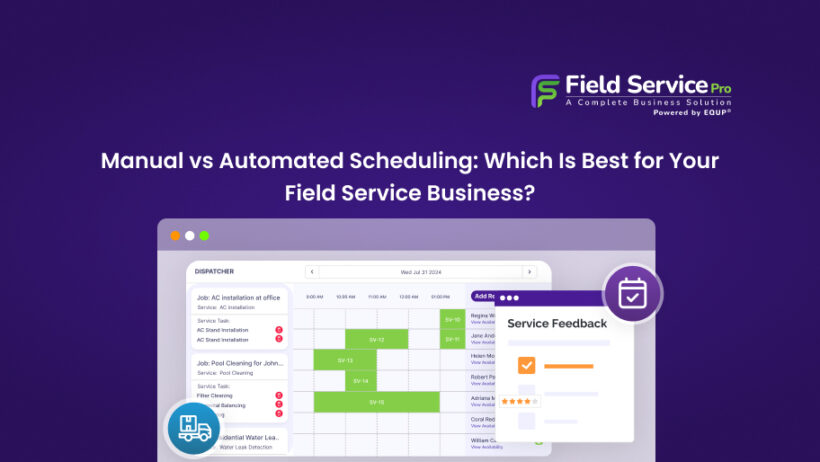
How Automated Scheduling Improves Field Service Operations

A proper field service management system helps you:
- View all jobs in one dashboard – Get a complete, real-time overview of scheduled, ongoing, and completed jobs without switching between tools or spreadsheets.
- Dispatch technicians based on availability – Assign work intelligently by seeing who is free, nearby, or already booked, reducing delays and overload.
- Track work orders in real time – Follow job progress as it happens, so you always know what’s done, what’s pending, and what needs attention.
- Send automatic SMS/email reminders – Reduce missed appointments by notifying customers and technicians automatically before scheduled visits.
- Reduce no-shows – Clear reminders and confirmations help customers remember appointments and respect scheduled time slots.
- Avoid double bookings – A centralized scheduling system prevents overlapping assignments and keeps technician calendars accurate.
- Monitor technician performance – Track completed jobs, response times, and workload to understand productivity and improve planning.
- Improve response times – Faster visibility and smarter dispatching help you respond to service requests quickly and close jobs sooner.
Instead of chasing updates, you manage operations from a centralized platform. That’s the difference between surviving and scaling.

Manual vs Automated Scheduling: Real-World Comparison
Choosing between manual and automated scheduling isn’t just about technology. It’s about how your field service business runs day to day.
At first, spreadsheets, phone calls, and WhatsApp messages may seem manageable. But as job volume increases and teams grow, small gaps turn into daily friction.
To understand the difference clearly, let’s compare manual scheduling and automated scheduling in real-world field service conditions.
| Area | Manual Scheduling | Automated Scheduling (Field Service Software) |
| Job Visibility | Jobs are scattered across sheets, chats, and calendars | All jobs are visible in one centralized dashboard |
| Technician Dispatch | Assigned through calls or messages, often reactive | Assigned based on availability and workload |
| Double Bookings | Common when updates are missed | Prevented through real-time calendar syncing |
| Customer Reminders | Manual calls or forgotten follow-ups | Automatic SMS/email reminders reduce no-shows |
| Work Order Tracking | Status updates require calls and manual checks | Real-time updates visible instantly |
| Scalability | Works for very small volume only | Easily handles growth in jobs and technicians |
| Admin Time | High — constant coordination required | Reduced — system handles repetitive tasks |
| Reporting & Insights | Limited or no structured data | Built-in reports on performance and revenue |
Manual scheduling may work at a very small scale, but once you manage multiple technicians, recurring services, or 20+ jobs per week, manual coordination becomes inefficient and risky. Automated scheduling through field service management software doesn’t just save time. It:
- Reduces costly mistakes
- Improves technician productivity
- Enhances customer experience
- Increases daily job capacity
- Provides visibility and control
In simple terms, manual scheduling helps you survive. Automated scheduling helps you scale. For growing field service businesses, the difference becomes clear very quickly.
When Should a Field Service Business Automate Scheduling?
Automation becomes essential when:
- You manage multiple technicians
- You handle 20+ jobs weekly
- You handle 20+ jobs weekly
- You offer recurring services
- You struggle with dispatch coordination
- Revenue is lost due to missed bookings
Growing service businesses benefit the most:
- HVAC companies
- Plumbing contractors
- Electrical services
- Cleaning companies
- Maintenance providers
- Repair businesses
- Multi-location service teams
If scheduling mistakes are costing you time and money, automation is an operational infrastructure.
Choosing the Right Field Service Scheduling Software
Not every scheduling tool is built for service businesses that manage technicians, work orders, and customer appointments daily. Generic calendar apps or basic booking tools may handle time slots, but they don’t solve the bigger operational challenges.
A proper Field service management system should give you visibility into jobs, technician availability, dispatching, reminders, and performance, all in one place.
It should reduce coordination work, prevent double bookings, and make it easier to manage growing job volumes without adding more admin effort.
This is where FieldServicePro fits in. It’s more than just a scheduling tool, it’s complete field service management software designed specifically for field service teams.
From job scheduling and technician dispatch to automated reminders and centralized dashboards, FieldServicePro helps small and growing service businesses stay organized and in control.
Instead of patching together spreadsheets, messaging apps, and separate calendars, you get one structured system built to support real-world field operations and scalable growth.
Final Thoughts!
Manual scheduling works only at a very small scale. As soon as you manage multiple technicians, recurring jobs, or higher appointment volume, spreadsheets start limiting growth. Automated field service management software helps you:
- Reduce missed appointments
- Improve technician efficiency
- Strengthen customer communication
- Increase daily job capacity
- Scale without chaos
If your field service business depends on organized scheduling and dispatching, upgrading your system is all about control — including better visibility into your field service pricing, margins, and job profitability. And control is what drives growth.