






Imagine it’s 6:45 in the morning. You’ve got 22 pools on the schedule, two technicians texting you asking for the day’s routes, and a customer calling to say they never got their invoice from last week. You’re standing in your kitchen, coffee in hand, flipping through a paper route sheet that got rained on yesterday.
This isn’t a horror story. For a lot of pool service business owners, this is just a Tuesday.
Running a pool service business is genuinely demanding work. Managing schedules, routes, service logs, and billing quickly becomes overwhelming without the right pool service management software. The actual pool cleaning? Most pros have that down. It’s everything around it, scheduling, dispatching, billing, chemical records, and customer communication, where things usually start to fall apart. That’s exactly the gap that pool service management software fills.
This guide walks you through everything: what this software actually is, who needs it, which features matter most, and how to figure out if it’s worth the investment for your specific operation.
What Is Pool Service Management Software?

Pool service management software is a platform built to run the operational side of a pool service business. It handles the jobs that eat up hours of your day, including building schedules, tracking service logs, dispatching techs, generating invoices, and communicating with clients, all from one place.
Think of it as the back office you never had to hire.
Where a generic business tool like a spreadsheet or a calendar app handles one piece of the puzzle, pool service management software connects all those pieces. A technician finishes a job, service readings, uploads a photo, and marks it complete, and the system automatically fires off a service report to the customer and queues the invoice. No phone calls. Zero manual entry. No chasing.
It’s different from general field service software, too. Pool businesses have specific needs that don’t apply to, say, an HVAC company. Recurring weekly visits, seasonal scheduling, multiple service tasks per stop, and compliance documentation. A purpose-built pool software accounts for all of that. Generic tools often don’t.
Who Actually Needs Pool Service Management Software?

Here’s a misconception worth clearing up early: this isn’t just for large companies with fleets of vans and offices full of staff. The need for this kind of software shows up much earlier than most people think.
1. Solo Operators and Owner-Operators
If you’re running 40 to 80 pools on your own, you’re probably managing more admin than you realize. Text messages to customers when you’re running late. Invoices sent days after a job because you forgot to log it. Manual billing at the end of each month that takes a full weekend.
Pool service software doesn’t just help you look more professional, but it also gives you time back. When invoices go out automatically, when customers get notified without you picking up the phone, and when your route is optimized so you’re not backtracking across town, you gain hours every single week. Those hours can go toward picking up more accounts.
2. Small Teams (2–10 Technicians)
This is where operations get complicated fast. Once you have more than one tech on the road, coordination becomes a real problem. Who’s going to which pool? What did the other tech log last week? Did the customer on Route B get their invoice?
Software solves the coordination layer. You can assign routes from your phone, see where techs are during the day, review service logs from any job without making a call, and send invoices in bulk without touching them one by one.
3. Multi-Route Companies and Larger Operations
At this scale, flying blind can be inconvenient and expensive. Missed service visits, inconsistent service records, and billing errors become direct revenue losses. Pool service management software at this level acts as an operational backbone, keeping every moving part accountable.
Commercial accounts such as hotels, HOAs, apartment complexes also require a different level of documentation. Digital logs and service reports aren’t a nice touch at that stage; they’re often a requirement.
Features of Pool Service Management Software That Actually Matter
Not every feature in every software product is worth paying for. Below is the breakdown of what genuinely moves the needle for pool service businesses.
1. Recurring Job and Visit Scheduling
This is the core of any pool service operation. Customers need weekly or bi-weekly visits on a fixed schedule, and those visits need to happen consistently, with the right technician, at roughly the right time.
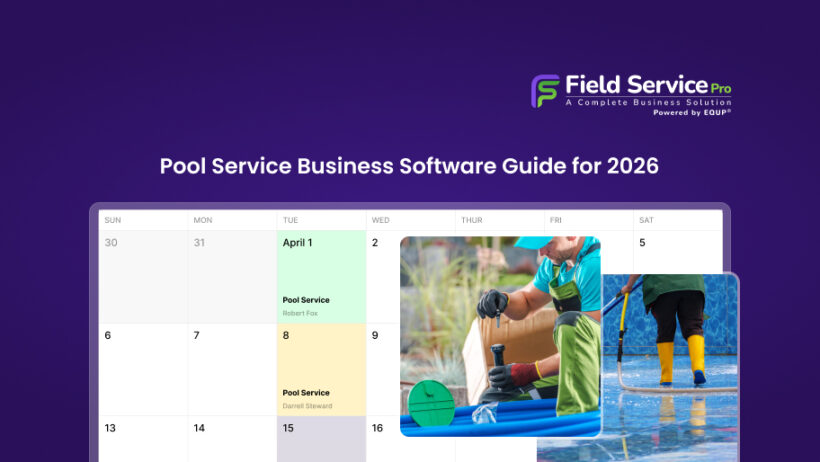
Good pool service software lets you set up a recurring job once, say “Weekly Maintenance for the Johnson property, every Thursday”, and the system generates every future visit automatically. No rebuilding the schedule each week. If a customer needs a one-off repair call, you can add it without touching their regular schedule.
Learn more about service scheduling software and how it handles recurring visits.
The difference between this and manually scheduling through Google Calendar or a whiteboard is significant. Manual scheduling doesn’t scale. It also breaks every time something changes.
2. Route Optimization
Fuel is expensive. So is time. A technician who drives 80 miles to service 14 pools in a day, because those pools are scattered inefficiently across a route, could do the same 14 pools in 55 miles with a smarter route.
Route optimization takes your day’s scheduled visits and figures out the most efficient driving order. Some platforms update routes dynamically if a visit gets cancelled or added. Over a week, this can shave hours off drive time across your team.
3. Service Logs and Job Documentation
Many small pool businesses still record several readings like pH, chlorine, alkalinity, and calcium hardness, on paper. These notes often get lost or never properly stored, creating both operational gaps and potential liability issues.
A good pool service management system lets technicians service logs and service details directly from their phone during each visit. The data is automatically saved in the customer’s service history.
If a customer later asks about an issue, you can quickly pull up past readings and job records to see exactly what was logged.
For commercial pools, keeping proper service documentation is often required for compliance.

4. Mobile App for Technicians
Your techs aren’t in an office. Any software they have to use sitting at a desktop is software they won’t use properly in the field.
A good mobile app lets technicians start their day by pulling up a list of their assigned visits, navigate to each stop, see any special instructions or gate codes, complete a digital service checklist, service logs, take photos, and close out the visit, all from their phone.
When the visit is marked complete, the customer can get an automated notification. The office sees the update in real time. There’s no paperwork to drop off, no check-in call to make.
5. Before and After Photo Documentation
One of the simplest features that makes a dramatic difference in customer trust and dispute resolution. Technicians take a photo when they arrive (before the service) and again when the work is done (after).
Those photos timestamp automatically and attach to the visit record. If a customer ever says “your tech didn’t show up” or “the pool was left in bad shape,” you have documented evidence. Over time, consistent before-and-after reports also become a selling point, customers appreciate seeing proof of the work being done.
6. Automated Invoicing and Billing
Invoicing is the task pool service owners most commonly put off, and it costs them real money. Delayed invoices mean delayed payments. Manual invoicing means errors.
Pool service management software ties billing directly to completed visits. Set it up once, flat monthly rate, per-stop billing, or whatever your model is and invoices generate and send automatically based on the schedule. Customers can pay online, which speeds up your cash flow and removes the check-in-the-mail waiting game.
7. Customer Notifications and Communication
Customers want to know when their tech is coming and when the job is done. Most service businesses handle this with phone calls or one-off texts, which is fine when you have 15 customers. It doesn’t work when you have 150.
Automated notifications, “Your tech is on the way,” “Your pool has been serviced,” “Here’s your service report,” run in the background without any manual effort. The result is a better customer experience with less time spent on the phone.
8. Online Booking
For pool service businesses looking to grow, an online booking option removes friction for new customers. They can request a service, pick a date, and even pay upfront without you or your office staff being pulled into a scheduling call.
Some platforms let you configure it so booking requests go into a queue for approval before they’re scheduled, which keeps you in control while still automating the front-end process.
What a Day Actually Looks Like With Pool Service Software
It’s worth walking through how these changes day-to-day, because the benefits are easier to understand in context.
6:30 AM. You wake up and check the app. Every technician’s route for the day is already built. You can see which visits are on the schedule, which accounts have notes or special instructions, and which customer requested a callback.
7:15 AM. Your tech, Marcus, starts his day. He opens the app and sees his 16 stops listed in order, already optimized. He taps the first one, gets turn-by-turn directions, and heads out.
8:40 AM. Marcus finishes his third pool. He logs the pH (7.4), chlorine (2.1 ppm), and alkalinity (110 ppm) directly in the app, takes a photo of the clean water, and marks the visit complete. The customer gets an automated text: “Your pool has been serviced. View your report here.”
11:00 AM. You’re at the office. You can see in real time that Marcus is on his eighth stop, two techs are running slightly behind schedule, and one customer called to reschedule their visit. You update the schedule from your laptop in 30 seconds.
5:30 PM. All visits are closed out. Invoices have already been queued. A batch of weekly billing runs automatically. No manual invoice writing tonight.
That’s a fundamentally different business than one running on paper routes and spreadsheets.
The Real ROI: Where the Hours Go
Small business owners across field service industries report spending anywhere from five to fifteen hours per week on admin tasks such as scheduling, billing, customer communication, and record-keeping. For a pool service business with a significant number of accounts, the upper end of that range is realistic.
Consider what that time is worth. If you value your own time at $50 an hour and you’re spending 10 hours a week on admin that software could handle, that’s $500 a week, or roughly $26,000 a year, in opportunity cost. Even with a software subscription, the math is straightforward.
The gains show up in other places too:
- Fewer missed visits. Automated scheduling with recurring jobs means appointments don’t fall through cracks. Missed visits are one of the top reasons customers leave pool service companies.
- Faster payment collection. Automated invoicing and online payment options cut the average payment delay significantly. Cash flow improves when invoices go out the same day the work is done.
- More stops per day. Route optimization doesn’t sound like much until you realize that a tech fitting in one extra stop per day, at $60 to $100 per service visit, adds up to thousands of dollars in additional revenue per tech over a season.
- Fewer customer complaints. Automated service reports and notifications reduce the number of “did your tech actually show up?” calls. Better records mean fewer billing disputes.
How to Choose the Right Pool Service Management Software
Before you sign up for anything, get clear on your own operation.
1. How many accounts do you have?
Some platforms price by the number of active customers or jobs. Know your current count and estimate where you’ll be in a year.
2. How tech-savvy is your team?
A complicated system with a steep learning curve is a system your techs won’t use properly. Ease of use in the mobile app is critical.
3. What’s your billing model?
Flat monthly rates, per-stop billing, one-off repairs make sure the software’s invoicing system supports how you actually charge customers.
4. Do you need online booking?
If customer acquisition is a focus, the ability for new clients to book directly from your website is a meaningful feature.
Is It Time to Make the Switch?
If you’re spending evenings catching up on billing, relying on paper to manage routes, or losing track of service history for your accounts, then YES, it’s time.
The U.S. pool maintenance and cleaning services market is experiencing significant growth, valued at over $8 billion in 2023 and projected to exceed $10 billion by 2029. The businesses growing within it are the ones that run efficiently, document well, and keep customers informed. That’s not a size thing. A solo operator with 60 accounts and a clean, professional system often outcompetes a 10-truck operation that still runs on whiteboards.
Pool service management software doesn’t change the work. It removes the friction around it, so you can focus on actually running the routes and growing the business.
Ready to See How Pool Service Management Software Works for Your Business?
FieldServicePro is a field service management software that helps service businesses manage scheduling, route optimization, job tracking, invoicing, and customer communication in one system.
For pool service companies, these tools make it easier to manage recurring visits, service logs, track technician activity, and keep customers informed automatically.
Whether you’re running 30 pools on your own or managing multiple technicians across several routes, the platform scales with you. You can import your customer list and have your routes set up on the same day.
See how FieldServicePro works for pool service businesses →