



Running a service business often feels like keeping a dozen plates spinning at once. Jobs come in, technicians head out, and customers call for updates. Then, somewhere in the middle, a paper invoice goes missing.
When you rely on whiteboards, spreadsheets, and a string of phone calls, things slip. Appointments get double-booked. Crews drive across town twice in one day. Invoices go out late, and cash flow suffers as a result.
If that sounds familiar, you are far from alone. Thousands of service businesses across the United States still run on a patchwork of disconnected tools. Most of them lose hours every week to avoidable admin.
The cost is rarely obvious on any single day. But it adds up fast across a month: missed jobs, idle technicians, frustrated customers, and revenue that quietly leaks out of the business.
This is exactly where the right software changes the game. The benefits of field service management software reach far beyond simple scheduling. The right platform connects your office and your field team. It turns scattered information into one clear view and helps every job move smoothly from first call to final payment. In short, it replaces guesswork with real-time clarity.
Thousands of service businesses across the United States still run on a patchwork of disconnected tools.
In this guide, we break down 5 real benefits that make a measurable difference. We also cover what the technology is, who it serves, and where it is heading. Whether you run an HVAC company, a plumbing crew, an electrical outfit, or a growing maintenance business, you will see how the right tool can reshape your operations and help you grow without the chaos.
What is Field Service Management Software?
Field service management software, often shortened to FSM software, is a platform that helps service businesses manage the full lifecycle of a job. That lifecycle includes:
- Capturing leads and scheduling work
- Dispatching technicians and tracking jobs in real time
- Creating estimates and invoices
- Collecting payments and following up with customers
In short, it is the central nervous system for a business that sends people out into the field. Instead of one tool for booking, another for invoicing, a separate app for payments, and a notebook for everything else, FSM software brings it all into a single, connected system.
The result is full visibility. The office sees what the field is doing, and the field sees what the office needs, all in real time. Nothing falls between the cracks, because there are no cracks to fall through.
A day without FSM software
To understand why this matters, picture a typical day without it:
- A customer calls to book a repair, and someone writes it on a whiteboard
- A technician gets the address by text
- The job runs long, but the office has no idea, so the next customer waits with no update
- The technician finishes and scribbles notes on paper
- Those notes sit in a truck for two days before anyone invoices the job
By then, a detail is forgotten, the invoice is wrong, and the customer disputes it. Every step in that chain is a place where time and money leak out.
The same day with FSM software
Now picture the same day with a connected platform:
- The booking goes straight into the system
- The nearest qualified technician is assigned automatically
- The customer gets a confirmation and an on-the-way alert
- The technician pulls up the full job history, completes the work, and captures photos
- The invoice is generated on the spot, and payment is collected before the truck leaves
That is the difference between scattered tools and a connected platform.
Modern platforms go a step further with field service automation software and AI. They handle repetitive tasks like appointment reminders, follow-ups, and route planning, so your team can focus on the work that actually pays. The technology has matured to the point where even a small team can run with the polish and reliability once reserved for large enterprises.
Overview of the Mobile Workforce
Service businesses live and die by their mobile workforce. Your technicians are rarely at a desk. Instead, they are on rooftops, under sinks, in basements, crawl spaces, and on the road between jobs.
That reality is why mobile workforce management solutions sit at the heart of any good FSM platform. After all, a tool that only works back at the office solves half the problem at best.
A mobile workforce needs information on the move. From the job site, technicians need to:
- See their schedule and pull up customer history
- Capture job notes and snap photos
- Order parts on the spot
- Collect payment without driving back to the office
Mobile field service applications put all of that in their pocket. In effect, they turn an ordinary smartphone into a complete job-site toolkit. The technician becomes self-sufficient in the field, which is exactly where you want them.
When your field team is connected, the whole operation speeds up. Jobs get logged as they happen, not hours later. Customers get accurate updates instead of vague promises. And the office always knows where things stand, so anyone can answer a timing question in seconds.
Happier technicians also stay longer, and in a tight labor market, retention is worth real money.
That kind of visibility used to require constant phone calls between dispatch and the field. Now it happens automatically. As a result, your office staff can focus on higher-value work instead of playing telephone all day.
There is also a morale benefit that often goes unmentioned. Technicians dislike paperwork as much as anyone. When the software handles forms, invoices, and reporting for them, they spend their day doing the skilled work they were hired for. Happier technicians also stay longer, and in a tight labor market, retention is worth real money.
Want to see this in action? Book a quick demo and watch a full job move from lead to invoice in one place.
Benefits of Field Service Management Software
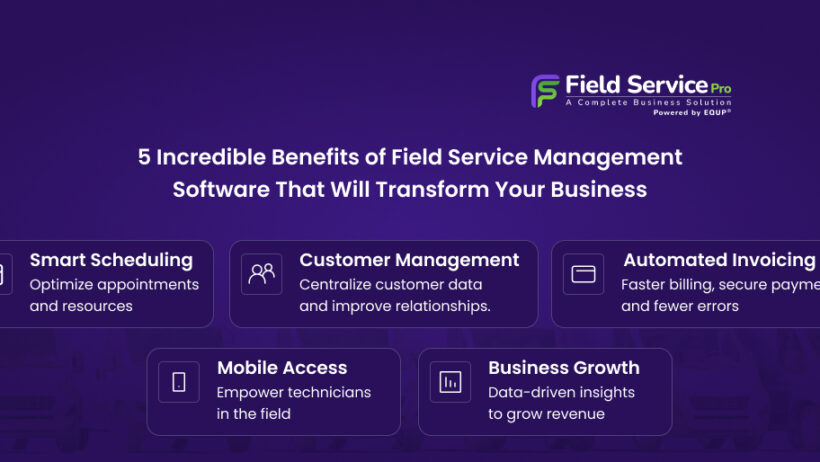
The benefits of field service management fall into five areas that work together to transform how a service business runs. Each one delivers value on its own. Before you weigh them, it helps to know how to choose field service management software that fits your team.
The real power, though, comes from how they reinforce one another. Let us walk through each in detail.
1. Improved Operational Efficiency
The first and most obvious benefit is efficiency. When every part of a job lives in one system, work flows smoothly. Your team no longer wastes time switching tools or chasing information.
This is not a vague promise. Efficiency shows up in concrete ways:
- Fewer wasted miles on the road
- Fewer dropped or forgotten jobs
- Less time spent coordinating by phone
Streamlined Scheduling and Dispatching
Manual scheduling is slow and easy to get wrong. One missed note leads to a double booking or a technician sent to the wrong address. Field service software replaces that chaos with smart scheduling.
You can see your whole team’s availability at a glance. Then you assign the right technician to the right job and adjust on the fly when plans change.
Automated dispatching also matches jobs by skill, location, and availability. Picture an emergency call at 2 p.m. Instead of scanning a whiteboard and making three calls, the system instantly shows who is closest and free. You assign the job in seconds, and the details land on the technician’s phone right away. Multiply that across every job, and the time saved adds up fast.
Good scheduling also cuts the hidden cost of backtracking. When jobs are grouped by location, technicians stop crisscrossing the same neighborhoods. As a result, your crew completes more jobs per day without working longer hours.
Reduced Response Times
Speed wins business. When a customer calls with an urgent problem, a fast response makes all the difference. With real-time visibility into your team’s location, you can dispatch the nearest technician right away instead of guessing who is free.
Fast response is also a competitive edge. In many trades, the company that shows up first wins the job. That is especially true for emergencies like a burst pipe or a dead furnace in winter. Over time, a reputation for responsiveness becomes one of your strongest marketing assets, and it fuels word-of-mouth referrals.
2. Enhanced Customer Satisfaction
Customers remember how a service felt. Were they kept in the loop? Did the technician arrive on time and fix the problem on the first visit? Was the invoice clear and easy to pay?
FSM software helps you deliver on all three. In a service business, that experience is the difference between a one-time job and a customer for life.
Real-time Updates and Notifications
Nobody likes waiting around for a vague four-hour window. Automated notifications keep customers informed with confirmations, reminders, and on-the-way alerts. This visibility builds trust. It also cuts down on missed appointments and no-answer doors, which waste your technicians’ time and fuel.
These small touches create a more professional image. A customer who gets a text saying their technician is fifteen minutes away feels respected and in control. Compare that to sitting at home all afternoon, wondering if anyone will show. The difference is night and day, and it costs you nothing once the system is in place. Customers notice the polish, and they reward it with repeat business and good reviews.
Increased First-Time Fix Rates
Few things frustrate customers more than a return visit for the same issue. Every repeat trip costs you fuel, labor, and goodwill.
The fix is preparation. When technicians arrive with full job history, customer notes, and the right parts information, they solve problems on the first trip far more often. A technician who can see that a unit was serviced six months ago walks in ready, rather than diagnosing from scratch. For the customer, the problem is solved fast. For you, the job turns a profit instead of becoming a money pit.
3. Increased Workforce Productivity
Your team does its best work when the tools support them rather than slow them down. FSM software removes the busywork that eats into productive hours. As a result, the same number of people can accomplish more in a day.
Utilizing Mobile Field Service Applications
Mobile field service applications let technicians handle everything from the job site. From their phone, they can:
- View schedules and customer details
- Complete digital forms and capture photos
- Generate estimates and take payment
Less driving and less paperwork means more billable jobs each day. That grows your revenue without adding headcount.
Consider the old way. A technician wrote notes by hand, drove back to the office, and handed paperwork to an administrator, who typed it up and sent an invoice days later. With a mobile app, that all collapses into a few taps on site. The job is documented, the invoice is sent, and payment is collected before the technician starts the engine. Across a week, that adds up to hours of reclaimed time and faster cash flow.
Performance Tracking and Feedback
You cannot improve what you cannot measure. FSM platforms track key metrics like jobs completed, time on site, and response times. This gives you a clear picture of how your team performs. The data helps you spot bottlenecks, recognize top performers, and coach where it counts.
This visibility is also fair to your team. When performance is measured objectively, strong technicians get the recognition they deserve. Those who are struggling get targeted support instead of vague criticism. Over time, the whole crew improves, because everyone can see what good looks like.
4. Cost Savings and Budget Control
Efficiency naturally leads to savings, and a good platform makes those savings visible and repeatable. In fact, the return on investment often shows up within the first few months, simply because so much waste disappears at once.
Reduction in Operational Costs
Every wasted trip, late invoice, and missed appointment costs money. FSM software trims those losses by optimizing routes, automating admin work, and speeding up invoicing. Technicians spend less time driving and more time working. Fuel costs drop. And you get paid faster, because invoices go out the moment a job is done.
Faster invoicing is a quiet but powerful benefit. Many businesses struggle with cash flow not because they lack work, but because money is stuck between finishing a job and getting paid. When the invoice goes out instantly, that gap shrinks. Better cash flow then gives you room to buy inventory, make payroll, and invest in growth.
Automation also keeps your overhead lean as you grow. Tasks that once needed a person, like sending reminders and chasing payments, now happen on their own. So your office costs stay low even as job volume climbs.
Better Resource Allocation
When you can see your whole operation in one view, you allocate people and equipment far more wisely. You avoid sending two technicians where one will do. You keep the right inventory on hand. And you balance workloads so no one sits idle while others scramble.
Inventory is a good example. Without visibility, businesses either overstock parts and tie up cash, or understock and lose time running to suppliers mid-job. Software that tracks parts usage helps you keep the right amount on hand. The same logic applies to your people. With the full picture in view, you staff each day to match real demand instead of guessing.
5. Scalability and Flexibility
Finally, the right software grows with you. What works for a three-person crew should still work when you have thirty technicians across several regions. Too many businesses outgrow their tools and face a painful switch at the worst possible time. The right platform prevents that by scaling alongside you.
Adjusting to Business Growth
Growth should be exciting, not painful. A scalable FSM platform handles more jobs, users, and locations without forcing you to start over. As you add technicians or open new service areas, the system simply expands with you.
Consistency matters more than people expect during growth. When every technician follows the same digital workflow, your tenth hire delivers the same quality as your first. That repeatability is what lets a small local business become a regional player without the wheels coming off.
Customization Options
No two service businesses run exactly alike. The best platforms let you tailor workflows, forms, job types, and notifications to fit how you actually operate. This flexibility matters across every trade:
- A pest control company needs recurring treatment schedules
- A plumbing business needs detailed job photos and parts tracking
- An HVAC company needs maintenance agreements and seasonal reminders
A good platform bends to fit each of these rather than forcing every business into the same rigid mold. When the software matches your real workflow, adoption is easy and the benefits show up faster, because your team is not fighting the tool to get work done.
Who Benefits Most From Field Service Management Software
While almost any service business gains from these tools, a few see especially strong returns and deserve a closer look:
- Contracting businesses: The benefits of field service management software for contracting businesses are significant, since contractors juggle multiple crews, job sites, and timelines that are nearly impossible to track on paper. A connected system keeps every project visible and on schedule, so a contractor can run several jobs at once without losing track of who is where or what still needs doing. For businesses that win or lose on tight margins and tighter deadlines, that visibility is the difference between profit and chaos.
- Maintenance contractors: The benefits of field service software for maintenance contractors center on recurring work. Maintenance teams handle repeat visits, service agreements, and preventive schedules, all of which FSM software automates so nothing slips through the cracks. When a contract calls for quarterly visits, the system schedules and reminds automatically, which means you never miss a renewal or a scheduled service that you are already being paid to perform. That reliability protects recurring revenue, the most valuable kind a service business can have.
- HVAC companies: The benefits of field service software for HVAC companies are clear during peak season. When the phones ring off the hook in summer and winter, smart scheduling, fast dispatch, and mobile access keep crews moving and customers comfortable on time. HVAC businesses also lean heavily on maintenance agreements and seasonal tune-ups, and FSM software keeps those programs running like clockwork, turning one-time repair customers into long-term service relationships that generate steady income year-round.
Key Takeaways
The benefits of field service management software come down to five outcomes that reinforce one another:
- Operational efficiency through smarter scheduling and faster response
- Higher customer satisfaction with real-time updates and better first-time fix rates
- Greater workforce productivity with mobile tools and clear performance data
- Lower costs through better routing, faster invoicing, and smarter resource allocation
- Confident scaling thanks to flexible workflows that grow with your team
Together, these add up to a service business that runs smoother, earns more, and keeps customers coming back.
The shift from scattered tools to one connected platform is more than a tech upgrade. It is an operational reset that touches every job you run, from the first phone call to the final paid invoice. Most businesses that make the switch never look back. Once you have felt what a connected operation is like, whiteboards and paper simply cannot compete.
And it is worth remembering the real point. The goal is not technology for its own sake. It is a better-run business: less stress, more profit, happier customers, and a team that enjoys the work. The software is just the tool that makes all of that possible, at a scale and consistency you could never reach by hand.
The Future of Field Service Management Software
The next wave of field service management software is built on AI and automation. Expect smarter dispatch that assigns the perfect technician automatically, predictive maintenance that flags equipment problems before they cause a breakdown, and AI assistants that handle scheduling and follow-up on their own. These are not distant promises. Much of this technology is already arriving in modern platforms, and it is reshaping what a small service team can accomplish.
Early adopters are already pulling ahead on speed, cost, and customer experience, a trend reflected in industry growth forecasts for field service management.
As mobile workforce management solutions keep advancing, the gap between businesses that adopt these tools and those that stick with spreadsheets will only widen. Early adopters are already pulling ahead on speed, cost, and customer experience, and that lead compounds over time. The businesses that thrive in the coming years will be the ones that treat their software as a growth engine rather than an afterthought.
If you want to run every job from lead to invoice in one connected, AI-native platform, FieldServicePro is built exactly for that. Start your free trial and see how the right software transforms your daily operations.
Frequently Asked Questions
The main benefits are improved operational efficiency, higher customer satisfaction, increased workforce productivity, lower operating costs, and the ability to scale as your business grows. Together they help service teams complete more jobs with less friction and less wasted time.
It gives technicians mobile field service applications to view schedules, access customer history, complete forms, capture photos, and collect payment from the job site, so they spend less time driving back to the office and more time on billable work.
Yes, even small teams benefit from automated scheduling, faster invoicing, and fewer missed appointments. Many platforms scale their pricing and features, so you can start small and grow into more advanced tools over time without overpaying early on.
Contracting businesses, maintenance contractors, and HVAC companies see some of the strongest returns, along with plumbing, electrical, cleaning, and pest control teams that rely on scheduling, dispatch, and recurring service work.
Many businesses notice improvements within the first few weeks, especially in scheduling speed and invoicing turnaround. Cost savings and productivity gains build over the first few months as the team settles into the new workflow and automation takes over routine tasks.